Pages

Saturday, September 20, 2014

The Biggest Eating Treat of Summer


Is there any vegetable that is more delicious than fresh corn on the cob?  We’ve never grown  our own on Locust Hill.  We get the sweetest corn grown in the Northwest Corner from the Fords in exchange for letting them use our pastures for their heifers each summer and.cut, bale and take away our hay. 

Not many people grow enough corn to freeze a batch for winter eating.  It takes up too much space in a backyard vegetable garden.  Most farm stands, however, will give you an extremely reasonable price when you ask for a bushel for freezing, especially if you offer to pick it yourself.  And I’m about to describe to you the fastest, easiest way to freeze it. If we get a killer frost before you get around to getting your corn, just tuck this column away for next year. 

Speed is the secret  to producing sweet, melt-in-your-mouth winter corn – from plot to pot to freezer.  For this job a corn scraper is essential.  I recommend Burpee’s Corn Cutter and Creamer.


It first slits the kernels and then scrapes them off the cob.  But even this stainless steel beauty is useless without something to support it.   Below is the simple box that Hank made for the job.  It has a lip at the  bottom to overhang the kitchen counter, and a top that holds the cutter in place.  The box is high enough so that a bowl can be slipped in the open side to catch the cut corn. 


This may  look a little complicated,  but believe me, if you’re about to freeze 20 or more pints of cut corn without spending all day in a steamy kitchen, it’s worth it.  Which reminds me - make sure you get a large fan to help keep you cool while you're working.

Next you need a large pot and cover with a rack in the bottom and filled with an inch of boiling water in which to steam the corn.  Below are pictured two cob holders made of hardware cloth that  take 5 ears, 3 on the bottom, two on top. Improvise with coat hangers if you don’t have hardware cloth.


Fill the sink with cold water and ice cubes. Steam the first 5 ears for about 5 minutes, then dump them in the cold water and put the next 5 ears in the pot to steam.   When the cooked corn is cool, dry it on folded dish towels, then cut the kernels  - CAREFULLY!  as the cutter is sharp.  Fill the freezer bags and replace the bowl beneath the cutter (Very easy to forget!)

I know this all sounds pretty complicated, but once you’re into the rhythm, you’ll find that all these steps take about the same five minutes as the steaming process.  And believe me, the corn you’ve frozen for winter eating will be melt in your mouth delicious!

A word of warning.  Don’t put off the job of cleaning up no matter how tired you are.  Corn turns to glue if left to its own devices.  Washing tools, counters and floor right away will save lots of agony.     


Saturday, September 6, 2014

Terrible Tree Troubles


Arbor Day is celebrated in Connecticut on the last Friday in April, but to me it makes more sense to plant trees in the fall, not the spring.  Asking a new tender sapling to produce new leaves and possibly flowers when its most delicate roots, the ones that take in water, are often damaged in transplanting, must be tough. .  I think tree planting makes a lot more sense when done in September when all it  needs to do is establish itself and then settle down to sleep through the winter.

Locust Hill has lost all too many good trees in the past few years.  The first one to die was the weeping hemlock that Hank planted out beside  the sauna.  He chose it just for the kids as it made a perfect hiding place.  When the girls got too old to play in it, we found a beautiful flat rock  to put  in front of the hemlock so  we could sit on.  So could the dogs.  

Two years ago the weeping shrub  began looking sick, and there were funny looking white places on its branches.  The tree expert who came to take a look claimed it was doomed.  The Wooly Adelgid was the culprit that killed it.

The next tree to perish on Locust Hill was an even sadder catastrophe, the huge sugar maple that provided shade for the front terrace. When we moved here in 1963 the maple’s trunk had a diameter the size of a gallon jug, but it grew faster than today’s national debt.  We soon learned why -  our family of 5 was feeding the tree  daily because the primitive septic system  was directly below its roots.

Fortunately Hank’s grandmother, knowing we hadn’t a penny to spare, offered to pay to have a new septic system put in.  From then on the maple grew normally until five years ago, 2009, when it suddenly began to look sick.  Neither of the two excellent tree experts who came to check out the poor tree’s problem had no idea what it could be.  


Three years later I bought a silver maple to take its place.  Silver maples grow a lot faster than sugar maples and this one was no exception.   When I finally faced cutting down the poor dead sugar last fall,  the new little sapling had grown amazingly tall, thanks to my squirting “Spray and Grow” on it every year.  Hopefully  by next summer we will sit in the shade while we eat and admire the view.   


Our Carpathian Walnut, which gave us a bushel of delicious walnuts for almost 40 years was also sick, but we knew why – every limb had been drilled with holes by sapsuckers, so the tree no longer could produce nuts, Last fall  I had it cut down along with the sugar maple.  What a  lot of firewood  John and I stacked in the long shed with both those huge trees gone!

The apple tree  beside the pond will be the next to go.  It must be at least 100 years old.  Last spring when the limb supporting grandfather’s handsome swing broke off what was revealed was a trunk as empty as my memory when I try to remember a good friend’s name nowadays.   


Fortunately its apples were always dry and tasteless and had never been worth harvesting.  Each fall they fell onto the lawn  where I had to gather them up so I could mow. This spring its leaves looked as sick as a puppy that's eaten a pile of rotten fish.  

That ancient tree, however, had given us the perfect limb on which to hang Grandfather’s swing. With both the sugar maple and the walnut gone, there wasn’t a single tree near the house with an appropriate limb on which to put the swing, and I ended up hanging  it  from a beam in the long shed.


Now it’s time to figure out what new sapling I should plant in place of the apple tree.  I'd love a dogwood, but I don't think it would produce a sturdy enough limb.  Since I’ll be long gone by the time whatever I plant has a limb sturdy enough to support grandfather’s swing,  I think I must consult daughter Bridget who will inherit Locust Hill and get her thoughts on what to get. 


I hope the trees on your property are all thriving.  If so, be thankful! 

Saturday, August 23, 2014

Feedback


What a wealth of new words we’ve acquired since the birth of the computer.  Instead of being in a rut, we’re programmed.  Instead of adding ideas to a discussion we add input. When we relax we go with the flow.  We don’t shut down the computer, we log off..  Cookies?  Not edible. They’re text files that Web publishers store on your computer.

Feedback is one of the more descriptive words to enhance our vocabulary.  I got instant feedback  in the years I gave my garden programs, as live audiences always send both good and bad  responses.   Weeds and Wisdom is totally different than public speaking.  When I first began writing columns I really wondered if there was anyone out there reading them.  Consequently  when the first emails began to trickle in they were extremely welcome, whether they praised or panned or just posed garden problems.

In one of my early columns about  wood ashes I  mentioned that I didn’t sift my ashes any more than I vacuumed under my furniture. This elicited my first response from a reader, an Electrolux saleslady requesting an appointment.  That wasn’t exactly what I’d call fan mail, but at least it meant someone was reading my articles.


I next heard from a lady in Sharon who was having problems with her beets and requested advice. Beets are not hard to grow, but they have some definite requirements.  Like all root  vegetables, they need loose, well-worked soil in order to grow plump.   The numbly little balls we plant are fruits that each contain several seeds, so within a few weeks of sprouting they need thinning. 

I find the process of thinning a morbid chore.  Pulling out unwanted plants is as upsetting as weeding out my  clothes closet of items that no longer fit. When I was young  it meant it was time to go on a diet.  Nowadays, having shrunk in my old age, it means shortening the hems on all my slacks. 

Beets like quite a high Ph, 6.8 to 8.0.  Remember the rhyme – when sweetened with lime, the Ph will climb.  Adding wood ashes helps, too, as they’re rich in potassium and phosphorous, both needed by beets.  One more requirement is the trace element boron, but this is usually plentiful, so don’t worry about it unless your beets have black, corky tissue.


A gentleman from Torrington once asked why his pepper plants had been bushy and full of blossoms the previous summer, but produced hardly any peppers.  All pepper plants are bushy because as soon as a stem produces its single flower and two leaves, the auxiliary bud at the base of the flower grows into another branch, which also produces a single flower and two leaves, then… ad infinitum, all summer long.   Nights that are either too hot (80s) or too cold (low 50s) will really set pepper plants back, causing poor fruit or even no fruit at all. 

 Once pepper  plants pass the starting line on the race to harvest, they’re like marathon runners.  They like to set a nice steady pace and stick to it.  They insist on rapid, continuous growth to succeed.  If they stop to rest for too long they stiffen up.  To get a good photo of my plants I had to cut dozens of leaves and stems away in order to see the peppers. 

 A lady in New Hartford once wrote me that her pink poppies self-seeded each year, but she’d had no luck transplanting the young seedlings to other areas.  That’s because they have a long but very tender tap root that can’t survive transplanting. 


 I know you’ve seen this photo quite recently, but there’s no longer a single poppy in bloom by August. Below are the seed pods.  When they ripen you can open them and sprinkle their black coffee grounds in loose soil wherever you’d like new poppies to grow the following year.  They should pop right up the following spring.


A  reader who called herself a “blooming gardener” once requested I write a column on starting a flower bed.  Despite the fact that she addressed me as Hasty instead of Hatsy,  I eventually did so.  I get called Hasty quite frequently, probably because I often am.   You can call me Hasty or Hearty,  Harmless or Hopeless, but don’t hesitate to send me your feedback.    

P.S.  I've written about onions several times in past columns, so case you’re wondering –  my onions have looked so handsome this year I couldn't resist using their photo.                                                                                                                                                                                                                                                                                                                                                                                                                                                                                                                                                                                                                                                                                                                                                                                                                                                                                                                     


Saturday, August 9, 2014

Thousands of Books!


As many of you know,  the Norfolk Library has a book sale on the last weekend in August every year.  I am the volunteer who sorts the books donated for this event. I love this job, as I always discover books I’ve never read, take them home and return them before the sale.

The library accepts donations  beginning on April 1st, but this year we allowed a local book publisher to give the library 72 large boxes of books in January!  Since then the 36 foot long ramp that brings all donations down to my sorting table in the basement  has been almost continually full, despite my sorting at least 4 or 5 big boxes a day into categories.  


I have been overwhelmed by the amount of donations we’ve received.  I haven’t counted this year's total yet, but I bet it’s close to double what we had last year.  Everyone must be switching to E Books.  I have run out of  shelf space, so now the latest flats I label and fill for each category are being stacked on the floor.


You mustn’t miss this year’s sale! The Art category includes not just large and magnificent art books, but  books on music, theater, movies, photography and dance.  If you love cooking, you’ll find several hundred cook books (wine included) to wet your appetite.  If you have kids, the children’s category is full of beautiful but very inexpensive books. 

The Fiction category is always enormous, but this year History is almost as big.  In fact it is so big that we’ve divided it into two categories  -  one on History, the other on Politics.  There must be well over 200 books on Russia, including many written in Russian.  


The Health category  covers such subjects as Lime Disease, Alcoholism, Home Remedies,  and dozens of other informative subjects. Other categories include  Social Science, Travel, Sports, Foreign Languages,  Business (Finance), Large Print books, Technology, which covers a multitude of miscellany, and the one I drool over, Gardening and the Environment.  Prices range from  .50, $1.00 to $2.  

There are also “Books of Better Value” which are obviously priced separately.  That category includes First Editions, signed copies by authors, and handsome sets to fill those shelves you’ve all been emptying.  


My daughter Bridget  who's been helping me down in the basement, and her friend Toby Young,  have  agreed to take on the job of running the actual book sale.  Don't forget the dates - August 24 and  25, from 10am  until 4pm, with Free books after 2pm on Sunday. 

Hope I'll see all of you there! 

Saturday, July 26, 2014

Gray in the Garden


The other day it was so hot and sunny that I put the top down on my Miata before driving to the library  to sort book donations, a daily job.  Suddenly  some kind soul hollered down the stairs “It’s raining, Hatsy!”  I raced upstairs (I sort in the cellar)  to put the top up on the Miata. The job is not automatic,  and by the time I got home I was as wet as the driver’s seat.

The sunny day had become a gray day, so I decided to write this column about gray in the garden. The plant world  offers the gardener many choices  -  pearl gray, ash gray, ghost gray, slate gray, mouse gray.  Most of them are that color because they are “dead hairs that have turned white just as they do on human heads.”  I put quotes  around that comment from a book by Helen Fox,  a well-known garden authority, because I don’t quite believe it, do you? A human's white hair is dead hair?

One of the most common plants with gray foliage is Artimisea, sometimes called  wormwood.  It was given that unattractive label because an infusion made from its leaves and taken internally would supposedly dispel worms.  Another gray species is used to flavor vermouth, but I don’t believe martinis are the infusion I previously referred to. 

There are a confusing number of species of Artimisea, and I’ve spent most of my morning trying to sort them out.  I think the one in my own garden is A. pontica, at least the description fits.  It has an annoying habit of spreading by underground roots,  and often manages to spring up in the midst of an astilbe or a day lily, making it impossible to  remove.


This species has stiff stems that grow about two or more feet tall with delicately cut leaves the texture of soft felt.  Their blossoms come in August, panicles of inconspicuous yellow flowers hidden by gray bracts.  This species  provides a nice contrast in flower arrangements and if picked and hung up-side-down  to dry before it becomes spotted with brown, can be used in winter arrangements. 

Silver mound (A.schmidtiana) is another less conspicuous and better mannered Artimisea that only grows 10 or 12 inches high.  Its soft feathery leaves form  rounded hummocks.  It  prefers dry soil, and if it it’s allowed to get too wet or too big it will break down, losing its pincushion look, so it should be divided frequently.


I thought that Dusty Miller was another of the Artimisea tribe, but  my garden books claim it belongs in the Cineraria  family which includes both annual and perennial varieties.  Their leaves are a soft gray or silvery white, providing a nice contrast to the reds , pinks and blues of a flower garden.  The Dusty Miller , Senecio  cineraria,  has very white, finely cut foliage, prefers  lots of sun, and like the Silver mound, is quite small and well-behaved.


There are many other plants with gray foliage  –  lamb’s ears, the one with velvet leaves, one of the everlastings, German statice, and of course many herbs,  sage, rosemary, horehound.  Since I don't enjoy cooking, the only herb I grow is thyme, which makes a nice ground cover, so I know nothing about how these culinary plants grow.  

Ah, the sun has just appeared,  so I can avoid revealing my ignorance of herbs and get out into the garden.  


Saturday, July 12, 2014

Those Wretched Dandelions


Such an invasion of dandelions we had this spring! I assumed I'd have no trouble finding one to put in today's column, but I searched all week and that wimpy little one is the only dandelion still sporting a shaggy yellow head. All the others I saw had turned to fluff and were happily spreading their ripe seeds everywhere. 

There’s nothing dandy about a dandelion. Their  motto is “Never say die.” as everyone knows who has tried to get rid of them.  Dig as deep  as your shovel will go, loosen the soil and pull the plant with the utmost care, but I can guarantee  you’ll leave behind the last bit of the root, and that’s all a dandelion needs to produce a new plant.


This clever weed has what are called “contractile” cells living on its meristem that form the weak link, ensuring that the last bit of root will be left behind if the plant is pulled up. The cells living just below the break are called  “parenchyma” cells. They are so versatile they can divide to form any sort of plant tissue –  xylem, epidermis, phloem, etc.  (Good thing I took a botany  course once!)  The same sort of cells exist in the tail of a lizard. so he can grow a new tail.  The dandelion grows a new head.  

When these cells realize there is no longer a plant above their heads, they quickly produce dozens of new buds.  The tag end of the root also does a bit of growing so it can support those new buds, and before you know it a cluster of young plants has popped up in place of the one you thought you’d gotten rid of.

The dandelion’s  flower is actually composed of as many as 20 individual florets containing all the  parts needed to produce a seed.  Supposedly  if each tiny seed were to germinate, the earth  would be knee-deep in this hardy composite.  

Let’s face it, there will always be dandelions, so we might as well use them.  Their leaves can be  cooked  as greens or added to a salad.  Their roots can be turned into a substitute for coffee, although like most wild edible,  it doesn't compare to the real thing.  You really need to be pretty thirsty to enjoy a cup.

Dandelion wine, like dandelion coffee, is complicated to make, as the recipe requires you to pick four quarts of those yellow flowers and remove their bitter green leaves,  but the wine they produce is both palatable and potent.  My friend Edna Ford made a batch every spring, and I still remember the first time she offered me a glass.  

Dandelion wine looks  as clear and tastes as dry as a good commercial white wine,  I was under the impression that it was  a  little old lady’s drink, its alcoholic content inconsequential.  Edna and I sipped two small glasses apiece and much to my surprise, it turned out to be twice so strong that I was in such a fine state of inebriation that I was unable to drive home.

 Yesterday I suddenly remember how many dandelions had blossomed in my asparagus bed in May, and thought I'd get my camera and  go see if  I could find a bigger better blooming specimen.   I didn’t find a single one. What I did find, right nexty door in the raspberry bed, is pictured below.


These are annual poppies.  They appear on Locust Hill every summer. Sometimes when their tiny black seeds are ripe in September I open their pods and sprinkle them here and there, but I’ve never put them up in the raspberry bed.  Aren’t they beautiful!


Saturday, June 28, 2014

What a Garden!


How long has it been since we went on a garden tour? I used to do it every summer on Open House days, that great program produced by the Garden Conservancy. It’s a marvelous way to get new garden ideas. If you’re unfamiliar with the program, just Google the Garden Conservancy and you can get the entire summer schedule. Listed by states as well as by months, the dates and times that gardens are open and includes clear directions.

I haven’t taken the opportunity to visit a single garden since 2011, probably because I hardly have the energy to keep my own gardens looking respectable so I don't need to be tempted by new garden ideas.
But several weeks ago my friend Angie invited me to accompany her to see a Hosta Garden in Granby, Connecticut. 

Hostas are not high on my list of favorite flowers. The fact is that the flowers produced by these plants are a very minor part of their beauty. There were dozens of other plants besides hostas, however, attractively arranged and all clearly labeled.


Don’t miss the spectacular Hydrangea nomala petiolarisin in the background of the photo before we move on, full of bloom as it climbs up the large tree in the background of that photo.


John O’Brien is both the owner and the creator of the gardens, which I would guess contain more than a hundred different hosta species, and John knows the Latin name for every single one! He must have planted that hydrangea many years ago. It is one of the best of the ornamental vines and useful because it will grow and flower even in a northern exposure. Such a strong heavy vine needs very strong support, and Mr. O’Brien sensibly chose a tall sturdy tree for his hydrangea to climb. It is bursting with white blooms, but in winter its peeling reddish brown bark will be revealed. 

One could spend an entire afternoon looking not just at hostas, but a fabulous array of other plants as you meander down the hill to the brook, up past borders of iris, unusual trees and shrubs, all clearly labeled. We took so many photos that I don’t really need to say anything more, just give you a glimpse of the rare specimens, and offer some directions on how to visit this spectacular garden and its charming owner.


I fell in love with the soft colors of this beautiful tree peony called Kopper Kettle. This parsimonious old lady would actually have bought one, but none were available. Isn’t it delicious?


This fir tree, Silver Snow, whose Latin name is Abias koreana, originated in South Korean, and does well in cool moist areas of New England. It rarely grows taller than 30 feet. Its new spring growth is silvery white, and is followed by unusual looking purple cones.


A mountain laurel I’d never seen before is the one above, Olympia Fire. It has brilliant red buds that open into soft pink blossoms. Most laurels I’ve transplanted from the woods on Locust Hill have not done well, but I bet this already potted one, would be a success.


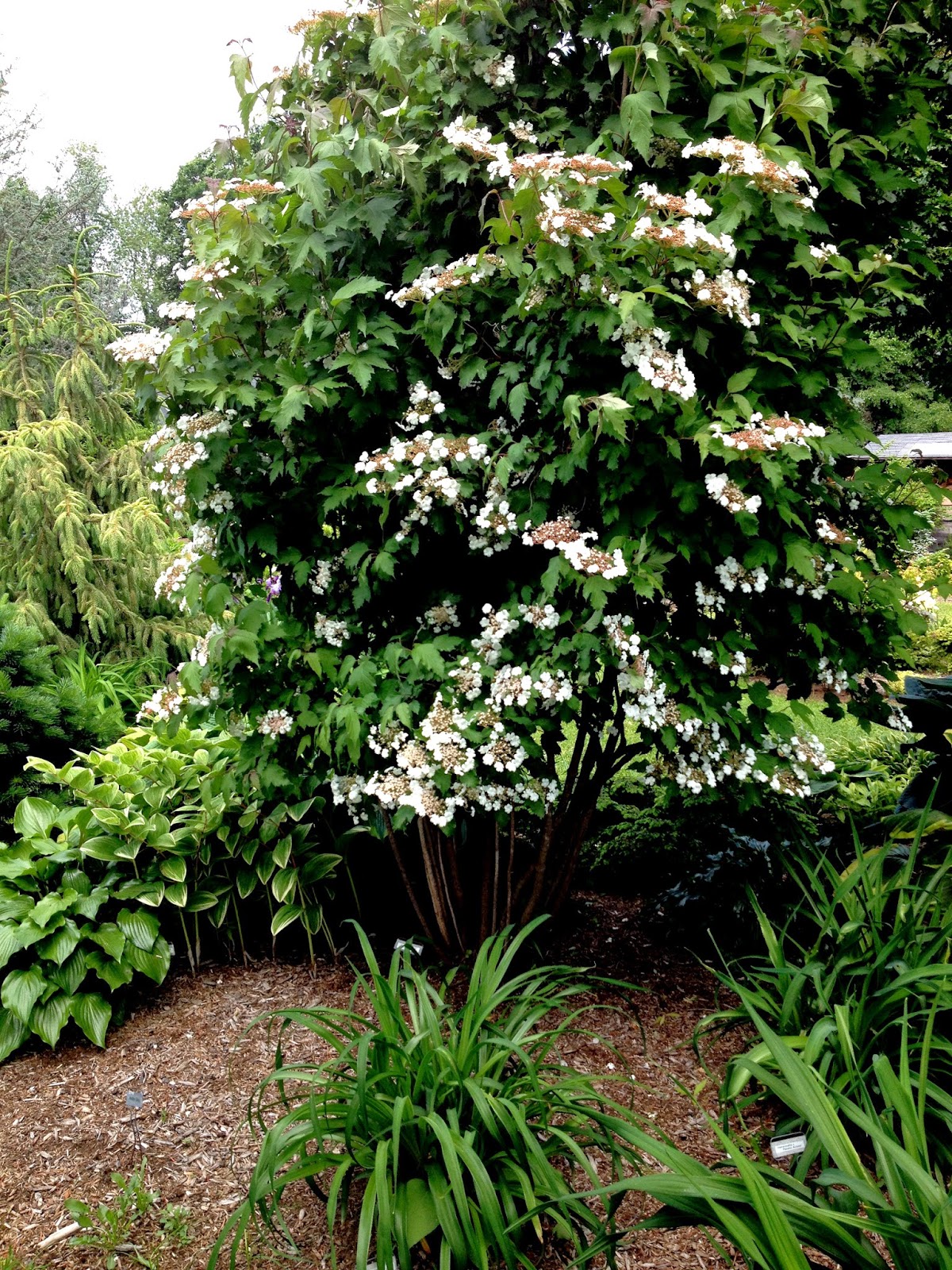
I found this viburnum so impressive. I’ve never seen one so big and healthy. The ones I’m familiar with, growing in wood edges, tend to be spindly, and have hardly any blossoms. Well, I guess just about everything in this garden is so happy under John’s care that it’s not surprising.

By now you probably have a pretty good idea of what an
incredible show of unusual plants (and not just hostas)  you can see in this Granby Garden.  If you take Route #20 toward Bradley         Airport, just before you get to the town of Granby,  take a left a   the red light onto Route #189.  Go less than two miles miles and      take a right onto Wells Road. #40 on your right you will have          reached  reachethis spectacular garden.   Enjoy!