Pages

Saturday, June 28, 2014

What a Garden!


How long has it been since we went on a garden tour? I used to do it every summer on Open House days, that great program produced by the Garden Conservancy. It’s a marvelous way to get new garden ideas. If you’re unfamiliar with the program, just Google the Garden Conservancy and you can get the entire summer schedule. Listed by states as well as by months, the dates and times that gardens are open and includes clear directions.

I haven’t taken the opportunity to visit a single garden since 2011, probably because I hardly have the energy to keep my own gardens looking respectable so I don't need to be tempted by new garden ideas.
But several weeks ago my friend Angie invited me to accompany her to see a Hosta Garden in Granby, Connecticut. 

Hostas are not high on my list of favorite flowers. The fact is that the flowers produced by these plants are a very minor part of their beauty. There were dozens of other plants besides hostas, however, attractively arranged and all clearly labeled.


Don’t miss the spectacular Hydrangea nomala petiolarisin in the background of the photo before we move on, full of bloom as it climbs up the large tree in the background of that photo.


John O’Brien is both the owner and the creator of the gardens, which I would guess contain more than a hundred different hosta species, and John knows the Latin name for every single one! He must have planted that hydrangea many years ago. It is one of the best of the ornamental vines and useful because it will grow and flower even in a northern exposure. Such a strong heavy vine needs very strong support, and Mr. O’Brien sensibly chose a tall sturdy tree for his hydrangea to climb. It is bursting with white blooms, but in winter its peeling reddish brown bark will be revealed. 

One could spend an entire afternoon looking not just at hostas, but a fabulous array of other plants as you meander down the hill to the brook, up past borders of iris, unusual trees and shrubs, all clearly labeled. We took so many photos that I don’t really need to say anything more, just give you a glimpse of the rare specimens, and offer some directions on how to visit this spectacular garden and its charming owner.


I fell in love with the soft colors of this beautiful tree peony called Kopper Kettle. This parsimonious old lady would actually have bought one, but none were available. Isn’t it delicious?


This fir tree, Silver Snow, whose Latin name is Abias koreana, originated in South Korean, and does well in cool moist areas of New England. It rarely grows taller than 30 feet. Its new spring growth is silvery white, and is followed by unusual looking purple cones.


A mountain laurel I’d never seen before is the one above, Olympia Fire. It has brilliant red buds that open into soft pink blossoms. Most laurels I’ve transplanted from the woods on Locust Hill have not done well, but I bet this already potted one, would be a success.


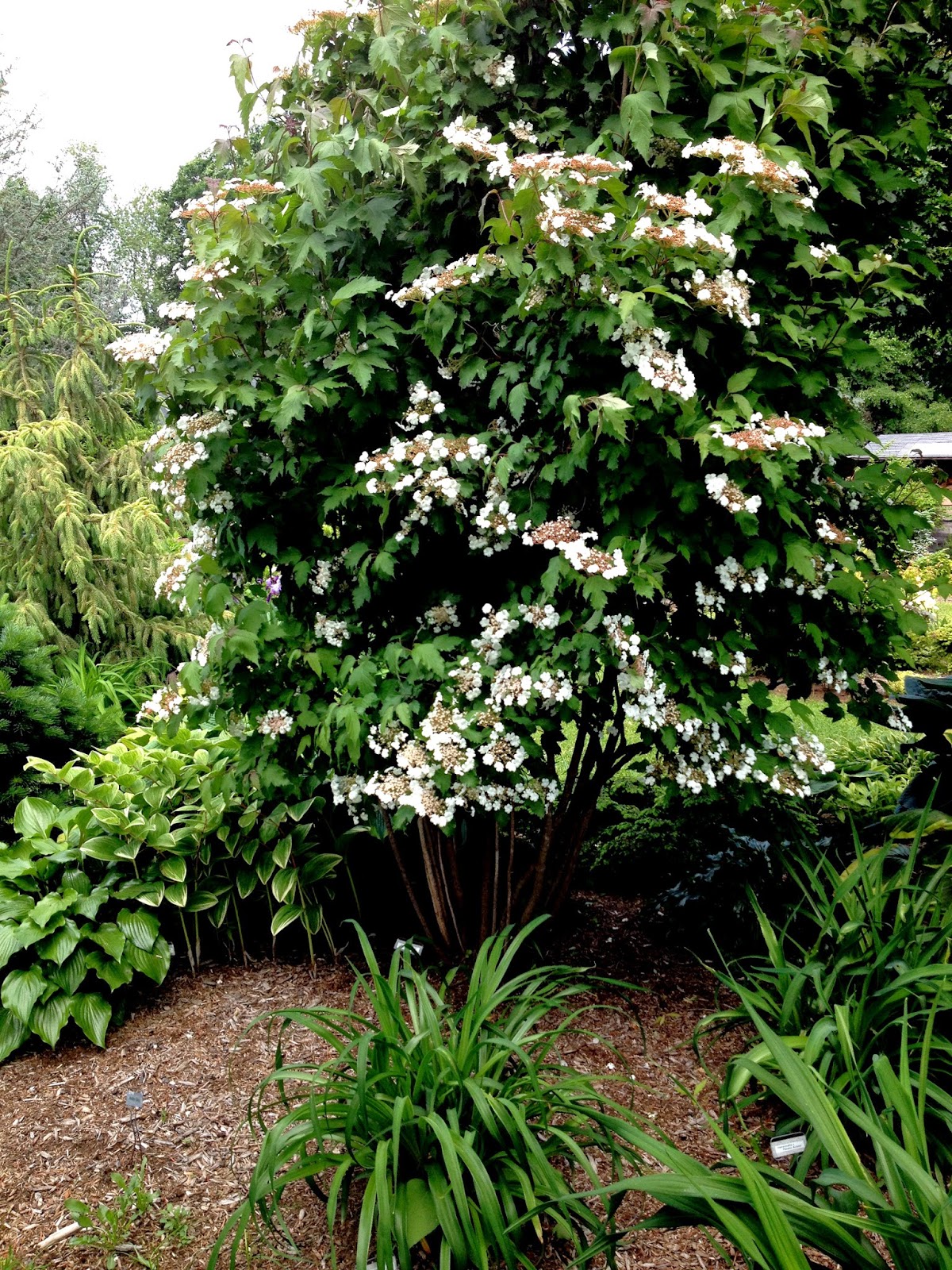
I found this viburnum so impressive. I’ve never seen one so big and healthy. The ones I’m familiar with, growing in wood edges, tend to be spindly, and have hardly any blossoms. Well, I guess just about everything in this garden is so happy under John’s care that it’s not surprising.

By now you probably have a pretty good idea of what an
incredible show of unusual plants (and not just hostas)  you can see in this Granby Garden.  If you take Route #20 toward Bradley         Airport, just before you get to the town of Granby,  take a left a   the red light onto Route #189.  Go less than two miles miles and      take a right onto Wells Road. #40 on your right you will have          reached  reachethis spectacular garden.   Enjoy!                                         

Saturday, June 14, 2014

A Short Column Today


Oh, dear, what shall I write about this week?  Now that Mother Nature has finally given us some beautiful weather, I’ve been too busy in the gardens to worry about Weeds and Wisdom.  

 Such a late start for planting vegetables, cleaning the debris in the perennial border, mowing the lawn every other minute,  weeding, weeding, and periodically  stopping my frantic efforts  to gasp and admire the spectacular beauty  Mother Nature has given us this year.

After the horrific winter and the non-existent spring, absolutely everything is magnificent.  The beauty and size of the flowers and shrubs is truly amazing. My tree peonies were bursting with blooms, my iris so tall and its blooms so heavy that every one needed staking,  Even my white lilac which lives in total shade on the north side of the house had a blizzard of bloom. 

My hayfields are so lush their blooming grasses are blocking my view of the valley.  My sheep, who had a terrible winter, can’t believe  their lush pasture.  My new beagle, Coco, can’t believe the bounty of rabbits she has to chase. Unfortunately my camera is the only item not performing, so I’ve no photos to show you. 

My one great sadness is that  poor old Clover, after sixteen happy years on Locust Hill,  died last week , Coco and I are mourning her passing, but she died so peacefully under her favorite beauty bush  that I felt happy for her.

I’m afraid  there’s still so much still to do outside  I hope you’ll forgive me for this very short column.   Here’s a nice old picture  in memory of Clover,  one of the nicest dogs I’ve ever had. 


Sunday, May 25, 2014

Tackling New Problems


Hi Readers.  How many of you own a computer? I bet at least 85% of you do, and I suspect your computers cause as much grief as mine does.  When I got my first computer, I was as thrilled as a caveman who’s been rubbing two sticks together to make his fire and is suddenly given a lighter. 

At first  I burned myself a few times, especially if I tried something new, at which point the screen would start blinking “INVALID ENTRY.”  When it did it about the 6th time I was so furious I screamed “Don’t call me an invalid!  I may not be doing well, but I’m not SICK!”

We old folks with fading memories have constant problems, even when we have a copy of   “Computers for Dummies”  to help us find solutions.  Of course tackling anything new is never easy, be it a computer,  the smartphone your kids gave you last Christmas or merely the instructions for your new car’s GPS.  

Since spring has finally arrived, I thought that instead of discussing all those high tech problems,  we should talk about something simple like planting the vegetable garden. The earliest vegetables we  can plant in our New England gardens are peas. Some garden books even suggest planting them as early  as St. Patrick’s Day.   

The first and only time I tried that no little seedlings appeared above ground and after two weeks I planted another batch of seeds. Peas won’t sprout if the temperature stays in the 40s,  All of mine popped up the following week as the temperatures rose. They were pretty crowded, but happily climbed the garden fence and provided me with plenty of snacks whenever I weeded the garden.  

Let’s look at another vegetable which can be safely planted right now, radishes.  Their seeds are big enough to handle easily, they sprout in only a few days, and are ready to harvest more quickly than any other vegetable.  All that may be true, but you can still produce cherry belles with the crunch of a sponge, white icicles with the bite of a jalapeno pepper, or some black Spanish that taste like garden dirt, so I’ve composed the following manual for Radish Culture.  If followed, it should produce good results and hopefully no frustrations.

                    RADISHES FOR DUMMIES

Plant Key:  The fatter the seed and the deeper it’s planted (one and a half inches), the bigger the radish.  If you like small radishes, plant the seeds only an inch deep or even less.  The ph should be somewhere between 6 and 8. Use lots of compost or well-rotted manure, but no fresh manure.  As with all root  vegetables, a loose sandy soil is best.

Grow Key:  Plant short rows since when radishes are ripe they are ready to pick for only a few days.  If left in the ground much longer, they’ll become tough and pithy.

Enemy Key:  To avoid the problem of root maggots, dig some hardwood ashes you’ve saved from all those winter fires into the soil before planting and spread a few on top as well to repel the flies that lay root maggot eggs.  Few other marauders bother radishes, although we once had an Irish Water Spaniel who adored them, the hotter the better.  He’d pull one up, hold the leaves between his paws, and chomp down on the red root.  Then his eyes would water and he’d foam at the mouth.

Save Key:  This function key is fortunately not necessary for radishes.  It is a very  important  key, however, and if forgotten to be used, catastrophe may result such as losing a completed column two hours before a deadline. 

Cook Key:  Don’t just use radishes as an appetizer.  Try putting these crisp vegetables in stir-fry dishes, in salads, or turn them into pickles. Add some radish leaves when you’re cooking spinach.  Although radishes are not particularly rich in nutrients,  a cup contains about 26% of the vitamins one should consume each day.

If you have trouble following this manual, don’t worry.  You may have sick radishes, but no one will pop up telling you you’re an INVALID!


Saturday, May 17, 2014

A Tiny Problem for Gardeneers

My apologies.  I deliberately chose a deceptive title for this  column. There’s no question but a tick, today’s subject,  is tiny, but if he manages to bite you, the result can be ENORMOUS – Lyme disease.


I  thought the frigid  snow-filled winter would reduce the tick population, but it’s had the opposite affect.  The number of ticks here in New England has exploded!   In past years  taking a walk in the woods was when we worried about getting a tick, but this year these wretched insects are absolutely everywhere.  


 Gardeners, BEWARE!  When you head out to do a little weeding, wear a long-sleeved shirt, long pants tucked into your socks (white socks and shirt will help you spot crawling ticks) and wear a hat. Spray an insect repellent such as Off around your ankles, and don’t assume that taking a hot shower after working outside is a solution. It’s not! 


                      An easy way to protect your dog from ticks!

 I’ve encountered many ticks over the years and been bitten five or six times.  Most bites are eventually  irritating enough so you soon realize you’ve got one. Unfortunately when you live alone, it’s hard to find these  horrid 8-legged insects.  You must  strip down and carefully admire yourself in the mirror.  YUCK!

This year my first tick bite was at the end of January when snow was piled high in all directions.  My second bite was on April 14th.  I didn’t feel it or find it until it had produced the nice rosy circle  indicating Lyme disease.  My doctor confirmed that fact as he wrote out a prescription for  Doxycycline.

 “One with breakfast, one with dinner, until they’re all gone,” said the pharmacist as she handed me a bottle  containeing 40 blue capsules.   “Oh, and stay out of the sun! These pills make your skin extremely sensitive.”  That advice didn’t sink in, so the next day after driving to town and back with my hands at 11 and 1 on the steering wheel, both hands looked like bright red lobster claws.

I didn’t know  when  or what sort of symptoms of Lyme would appear if I had actually gotten  it, and it wasn’t until April 29th that I learned.  I actually thought I’d broken my hip when I tried to get out of bed that morning.  Wow, what an incredible pain! 

Was having debilitating pain from my knee to my hip Lyme? That never occurred to me, but my doctor assured me it  was. Lyme disease can cause an infinite variety of problems, most of them muscular. It can affect any part of the body, even the brain, and can sometimes lasts for a year or more. 

Unable to even think about all the garden chores that needed doing, I decided to go on the Internet and read about Lyme disease. I wanted to learn more about this dreadful malady. I asked Google how Lyme disease got its name.  Up came close to a dozen websites on the subject.  I’d really hit the jackpot!


The first cases of Lyme disease were found  in Connecticut in a small town called Lyme. In 1975 a large number of children  living in the town became sick with what doctors thought was a new form of arthritis.  Many of the kids had some sort of insect bite as well. Eventually it was established that their aches and pains were not arthritis.  They were caused by tick bites.  The new disease was named Lyme,  in honor of the town?

Just off the coast beyond the town of Lyme is a small island which contains a biological testing facility, the Plum Island Animal Disease Center.  By 1954  the bio-warfare research being done at this facility  included experimental studies on a small insect, Borrelia urgdorferiin, the tick!


A word of caution - I’ve found that all sorts of information on the Internet appears to be written with such authority that it needs to  be read with a bit of skepticism, so take what follows with a grain of salt, or sugar or aspirin?    That said, here is a brief description of what I found. 

When it was established in 1975 that  the children of Lyme had all been bitten by ticks, people knowledgeable about the research being done on Plum Island immediately accused the research center of being responsible for the new disease, that obviously ticks had been poorly secured and birds had carried them over the water to the town.

According to several of the articles I read  the government denied there had ever been any experimenting with ticks, and not until some time in the 1990s was proof found that experiments with ticks had been performed. At that point  those responsible admitted that yes, at one time there had been a study of ticks at the facility. All this became known as the Lyme Conspiracy. It inspired dozens of articles, books and even a movie on the subject.

By the time I finished all this research myself,  my aches and pains were slowly beginning to shrink .  I trust they will soon fade away. Watch out for ticks this summer!  They are everywhere! 


Saturday, May 3, 2014

Ah, What Perfume!


Such endless wicked weather we’ve suffered through!  The only winter I can remember that was as cold and snowy was in 1977.  That year we  had a snowstorm in early May that bowed down the blooming lilacs!  Even though purple is my least favorite
color, I love those fragrant blooms and it was the first time I hadn’t been able to fill the house with their delicious perfume. 
Facing a column deadline, I decided to write about  fragrance in the garden. I pulled a few books off my shelves to see what flowers  have a potent aroma, and the very first book had a  huge list.  Sort of boring, so I decided to compose some doggerel to make it more interesting.

                The flowers fell aquarreling. They never could agree
                Whose fragrance was the sweetest, so they went and asked the bee.
                The bee agreed to act as judge – she does her job with pride.
                She sniffs and sips the whole day through, but still she can’t decide.
                The early blooming hyacinths, strong mints,  or marguerite?
           The four-o-clocks, the stately phlox, alyssum oh so sweet?
                Let’s not forget the violet, the handsome tuberose,
               The bee balm with its spiciness – such scents assail her nose!
               From peony to pink sweet pea, she buzzes through the beds,
               And as she sniffs, the blossoms smile and nod their pretty heads. 

                      Bee Balm,  Also called  Monarda                       

       Of the dozens of other fragrant flowers, one you may
  not be familiar with, a fancy flower with propane power -            just can't resist that doggerel - the gas plant.  Its foliage smells         strongly of lemon peel, but what makes it fun is that its cut       roots and summer flowers produce a highly flammable oil
that a match can ignite into a blue flame.  I've never grown a
a gas plant, but many years ago a neighbor who does, lit a     
 match and showed me how the flower lit up.                
              
Four O'Clocks

      Another fragrant flower in the list was the Four O'Clock. This annual produces blooms with many different colors in each one.  As you might guess, the flowers only open in the late afternoon.  They're similar in shape to Necotinana, a deliciously perfumed night bloomer.  Although Four O'Clocks are annuals, the ones I plant apparently leave enough seeds  to give me a second summer of plants if it's been a kind winter.
Finding good photos of fragrant flowers is difficult.  Naturally photographers prefer to choose the prettiest, not the most perfumed flowers, so I'm having limited success, but obviously you don't need a photo of one of the headiest blooms, the rose.  Dozens of roses were included on the list. They have by far the most delicious perfume.  I've had no success growing any but the common rambler that anyone can grow.  The list also included the tuberose, which is a bulb.  It doesn't do well in New England, however, as it is frost intolerant.  
Realizing that you're not learning much from this column, I looked in a few more books.    One titled Taylor's Garden Guide (not this Taylor) I found three long chapters devoted to fragrant flowers. I think it has enough information to fill three or four columns. Too late now.  With my deadline looming, I guess I'll tuck all of that info away for the future.  
  In the meantime, if you want your house to be filled with perfume, my suggestion is to go to www.logees.com, a rare nursery of unusual plants, and get yourself a pot of handsome gardenias or sweet smelling jasmine.       
                                      

           Gardenia             Jasmine            
                Fortuniana         Maid of New Orleans 


Saturday, April 19, 2014

The Most Reliable Plant of All


When I started writing  garden columns back in 1982 I had no trouble composing a new one each week, approximately 50 a year.  It wasn’t until 2001 that  I switched to writing just two columns a month.  Adding them all up comes to a total of more than 1100 columns.  No wonder I have  Writer’s Block!

 Nowadays when I pick a subject  I always check to see how long since I’ve written about it in a previous column.  Arbor Day? Colts Foot? Mud Season?  Spring Chores? I’ve covered them all, several more than once. Over the years I’ve written about bulbs 3 times, but this year they were the only cheerful sign of spring on Locust Hill, so excuse me if a bit of this column is familiar.

The first time I wrote about bulbs I was amazed when I discovered that the first bulbs resided to the tropics and had no bulbs at all. It was only when these plants migrated north to colder climates that they developed this unusual method of storage in order to survive. Wasn’t  Mother Nature clever to figure out a way to let these sweet flowers live in New England! 


If you slice down through the center of a bulb - a daffodil is easier to use than something as small as a snowdrop - you can see the tiny embryo,  protectively surrounded by layers of  leaves. This minute flower  is  just waiting for warm weather and water to allow it to start growing and become strong enough to push above ground. 

When I arrived home from New Orleans on April 1st I thought Mother Nature must be playing an April Fool's Day joke. The temperature was below freezing, the meadows still  a drab brown carpet, no eager red buds ready to open on the maple tree, not even any  bright yellow splashes of Colt's Foot blooms could be seen.

The only evidence of spring I saw were the brave little snowdrops, their tiny blooms looking like puffed rice.  They are by far the bravest bulbs to appear  each spring.   They will even force their way up through the snow, as you can see from the photo above.  Mine came so early that they’re already through blooming. 

I finally faced the unappetizing weather and spent ten minutes removing the clumps of dead leaves covering the crocuses and miniature daffodils so they could begin to show off.  


What other flowers can you plant that are more rewarding than bulbs?  They go on and on forever, free of diseases, increasing in size and beauty each year.  Plant a single narcissus and in a few years it has turned into two or three.  In five years they can be dug up, separated and the results replanted.  Provided you've marked the clumps that need dividing before their foliage disappears so they will be easily located when it's time to dig them up come fall, this cycle can be endlessly repeated.
I’ve repeated it so often that in 2001 I couldn’t think of another area that needed daffodils until Hank suggested I make a ring of them at the edge of the circle we mow under the Carpathian walnut so it’s easy to find the nuts.


That was a fine idea, but when the sapsuckers riddled the walnut with holes so it stopped producing nuts, I stopped mowing the circle.  Last year I had the walnut cut down, so now the  daffies are just part of the hay field, struggling to survive in the tall grass.  

I’m afraid  that’s just too bad.  Even if I had a new area to transplant them to, I haven’t the energy to even think about it.  There are far too many other spring chores to do.

Hopefully some of you will be inspired to tie a few of your bulbs with colorful ribbon this spring so they can be divided and transplanted come fall.  And I would be delighted to hear from any of my readers who have subjects they like me to write a future column about. 


Saturday, April 5, 2014

Just a Poem .


I’m back home from a great vacation in New Orleans, an entire week of good food, good laughs and fun tennis with my three girls,  It was a delight, but I am still in shock to find winter is still with us in New England.  Nothing in bloom, not even Coltsfoot, which usually sits on the roadsides shaking its shaggy yellow head by the first of March.  I was actually planning to write about it, but I seem to be suffering from Writer’s Block.  My solution is to  offer you the first song I composed when I began my career as a garden club speaker.    Hopefully I’ll get out of this rut soon,.


                                                    Passing a shady glen one day
                                                    I overheard a  violet say
                                                    “Listen girls, some botanist
                                                    Has made a Conservation List”
                                           

                                                    The gossip  flew like windblown seed
                                                    From bud to blossom, weed to weed.
                                                    Each flower felt to lack a place
                                                    Upon the list would mean Disgrace!
                                             

                                                   “Am I included?” asked Gentian fair,
                                                   “I’m delicate and very rare.
                                                   ”She blooms so late she shouldn’t be,”
                                                   The Adder’s Tongue hissed nastily.


                                                  “I need protection,” wailed  Wild Lupine.
                                                  “No more than me!” snapped Columbine.
                                                  The Bluets giggled at the fuss,
                                                  Then chorused sweetly “What about us?”

                                                  The beebalm gave a raucous laugh
                                                  And shook her shaggy head.
                                                  But then in deep embarrassment
                                                  She blushed a rosy red. 
                                              

                                               The delicate Hepatica
                                               Who rarely spoke a word
                                               Inquired, “Am I on the list?”
                                               But not one word was heard


                                             The Bloodroot, trembling and afraid,
                                             Her petals falling in the shade,
                                             Was sure the awesome botanist
                                             Had not put her upon his list.


                                            But Dutchman’s Britches who was near
                                           Quickly whispered in her ear,
                                           “I think your name was at the top.”
                                           And smiled to see the teardrops stop.